
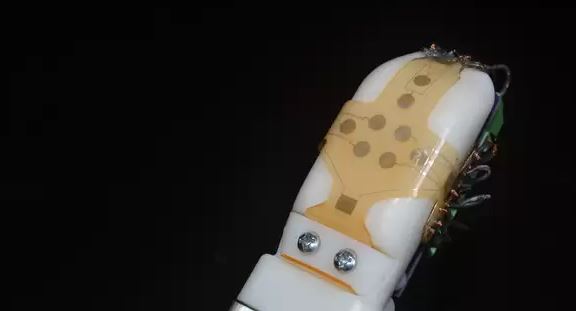
American scientists have developed a flexible material that should make robots ‘feel’ better. The material works just like human skin.
Researchers from the University of Washington and UCLA developed the robot skin because it is still very difficult for robots to grasp objects and feel how much force they have to apply.
The flexible material can be stretched over all parts of a robot, for example around a ‘finger’. Like human fingers, the robot can then sense vibrations and other forces as the material sweeps over another object. That makes it easier to grab objects.
“Currently, robots and prosthetic hands really rely on visual cues, such as, ‘Can I see my hand around this object,’ or ‘Is it touching this wire,'” said study researcher Jonathan Posner. “But that, of course, is incomplete information.”
Metal
The new material allows a robot to feel, among other things, whether an object is slipping through its hands. According to the researchers, this was not yet possible with other fake skins.
The material is made of silicone rubber containing tiny channels filled with conductive metal. The deformation of those channels, with a diameter half as small as a human hair, changes the amount of current that can flow through the metal. This way the robot can ‘feel’.
The scientists say they were inspired by the way human skin deforms around a fingernail when a finger is run across a table top.
Image: UCLA Engineering